
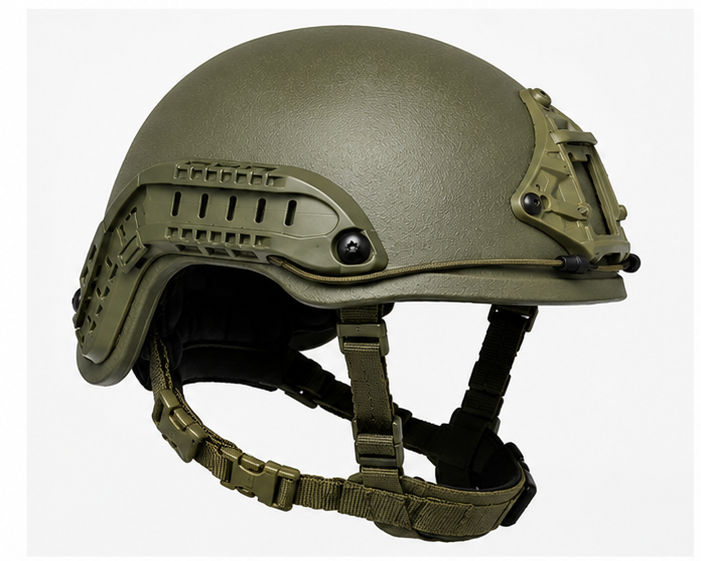
Ballistic Helmet
A ballistic helmet is a protective headgear used by military and law-enforcement personnel to protect against bullet fragments, shrapnel from explosions, and blunt-force trauma. Unlike older steel helmets, modern ballistic helmets are made from advanced composite materials (aramid fibers like Kevlar/Twaron, or UHMWPE) that offer a much higher strength-to-weight ratio - meaning better protection at a fraction of the weight, allowing longer wear without fatigue while still supporting mission accessories like night-vision devices and communication gear.
Key Features
- Ballistic Protection Protects against fragmentation from grenades/artillery, shrapnel, and in many cases direct hits from handgun rounds or lower-velocity rifle rounds (e.g., 9mm, or AK-47 7.62×39mm mild steel core in high-end variants). Rated by standards like NIJ (US) or equivalent military GSQR specifications.
- Retention & Suspension System A four-point (or more) adjustable chin-strap harness combined with an internal padded suspension or memory-foam liner, ensuring a secure, stable, and comfortable fit across different head sizes and movement conditions.
- Modular Accessory Integration Side rails, front shrouds, or NVG mounts allow attachment of night-vision goggles, tactical lights, communication headsets, visors, and mandible/face guards - adapting the helmet to different mission roles.
- Camouflage & Cover Compatibility Comes with helmet covers in various patterns (olive green, desert tan, MARPAT/camo, etc.) for concealment, and is designed to fit under/with body armor and other combat gear without impeding mobility.
- Lightweight Composite Shell Constructed from aramid fiber (Kevlar/Twaron) or ultra-high-molecular-weight polyethylene (UHMWPE), keeping total weight typically between 1.2–1.6 kg, far lighter than legacy steel helmets.
- Low Back Face Signature (BFS) Engineered to limit "back face deformation" - the indentation on the inner shell when hit - to below a safe threshold (commonly under 20mm), minimizing blunt trauma transferred to the skull even if the shell isn't penetrated.
- Environmental & Comfort Durability Designed to perform across extreme temperature ranges (often -50°C to +60°C), resist moisture/humidity, and include anti-allergic, sweat-resistant padding for extended combat wear